
GUIDES


Archived article. First published in 2017, kept for the record — some details may be out of date.
What is creative testing and what is it for? This scary thing makes up a significant share of the expenses of any media buyer, webmaster, marketer and people in other walks of life too.
What interests us is how to not blow the entire ad budget on that very testing.
So, why do you need testing? In two cases:
- Testing as a method of finding a combo
- Optimizing a combo
First of all, you need to understand that any offer is created for a target audience, and never the other way around.
For weight loss, for example — these are overweight people who want to lose extra weight.
When a person doesn’t get regular physical activity, the body starts storing fat. With age people move less, and after 21 they also stop growing (fat isn’t converted into growth). People usually finish university at 21-22, and we’re interested in people who can buy a product, not the unemployed. So let’s add a few more years for the person to find a “desk” job.
In 90% of cases men usually don’t care about their weight, so we cut them off.
It turns out the core target audience of any weight-loss offer is Women 25+.
The rest of the offer’s audience is fairly small, the ads will be very hard to target, and you’ll most likely run at a loss.
All web resources are also initially aimed at a specific audience. Find a resource with an audience close to your target — and half the job is done.
For your information: “In any teaser network, their managers will tell you which audience is dominant for them. It’s no secret. But it can make your life easier.”
So why do you need testing if everything’s already figured out? If you can just ask the teaser network whether they have such people or not?
Testing isn’t for finding the target audience, it’s for understanding how to best interest that audience.
Even the coolest product with no analogues won’t sell for 1 ruble if you don’t explain to the person that they need it like air.
LOOKING FOR COMBOS
A combo is a teaser/banner/post, a pre-lander (if any), and a landing page.
We choose the ad network and the advertising method depending on the target audience.
Teasers
For teasers we care about 2 parameters — CTR and the number of conversions. (here’s a teaser in MGID as a gift)
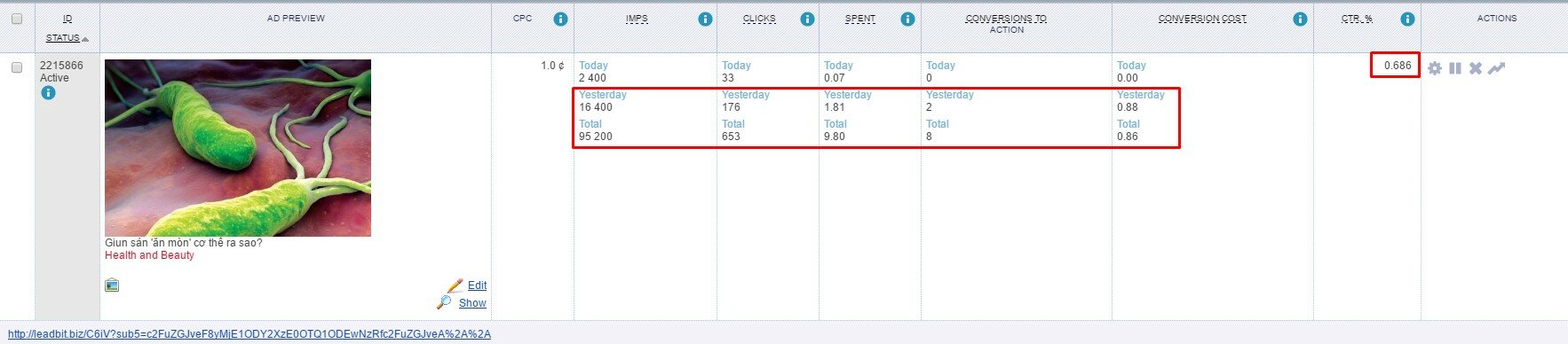
In teaser networks it doesn’t even make sense to work with a CTR below 0.3%. When working with targeted advertising, CTR should be no lower than 2%.
- Scary and disgusting images pick up clickability well, it’s just hard to get them through ad moderation.
- Faces of doctors and celebrities also get a decent CTR.
- Also, most sites (except movie ones) have a light background, which means bright contrasting colors in images attract attention better.
- If you advertise on movie sites, it’s better to use teasers with a white background.
The teaser must match the product. It’s easy to get a high CTR on a teaser with the phrase “DON’T CLICK THE LINK!”, but it’s unclear what such traffic is good for. The main task is to get product orders.
In practice, what works well:
- When the headline resembles the teaser text;
- When the teaser immediately has a description of the product, its image, the word “buy”, etc. Only such teasers don’t give a normal CTR;
- In general, what’s important in combos is the integrity of the “key idea”, i.e. on a teaser “Bad breath is a sign of parasites” there should next be a pre-lander about “bad breath being caused by parasites”. Then the landing page about parasites should mention: “If you have bad breath — it’s definitely parasites”. Trivial, but people far from the topic of what they’re selling often sin with this. It’s easy to find counter-examples like: “Back pain?” + a pre-lander “how to cure joints”. Such a combo is hard to run in the black a priori (unless, of course, your traffic is free), because these are different things.
Teasers are actually rarely tested. Mostly you launch as many as possible and then switch off the ones that can’t pick up CTR.
If the CTR is good but there’s no conversion, you can try changing the teaser’s pre-lander and/or landing page.
Lifehack: you can make packs of 2-5 similar teasers, make a new campaign for each pack, so that you can swap the promo or even the offer when needed without losing CTR.
A GUIDE TO ACTION
How long you should run teasers will depend on: the cost per click, whether you have a blacklist, and whether it’s a ruble or a regular offer.
You run teasers the same way you build a blacklist. Run the cost of 1 lead; if there are fewer than 2 requests (fewer than 3 for ruble offers) — stop. When there’s no blacklist, you can run more than the cost of 1 lead.
Good teasers and banners don’t live long, usually up to a month. But ads in contextual search live much longer, up to a year… unlike accounts 😉
This is called banner blindness. Why does it happen? Users get tired of the image.
You don’t need to throw teasers away — after running it a month, give it a month or two to rest. Then you can run it again.
Lifehack: if you start running a teaser at 1-2 a.m., the CTR will be higher from the start because there’s less competition))) But there’s little traffic at night and it converts worse. So be careful.
PRE-LANDER AND LANDING PAGE
First of all, a pre-lander DOES NOT SELL THE PRODUCT; it exists to INCREASE TRUST in the product.
The main criterion we care about in pre-landers is the click-through. And the click-through must be on target, i.e. the user should click the “go to site” button or the product name. A normal click-through is considered to be around 20% (1 in 5). The order from the landing page should be no more than 1 in 20. That gives a conversion of 1 in 100.
With these numbers you’ll confidently run in the black at a click price of 3 rubles.
A person buying a product does it on emotion. Raising emotion is one of the pre-lander’s tasks. And that’s the first thing to pay attention to when choosing it.
You yourself should be the first testing link. The pre-lander should be interesting to read even for you, and even better when you feel a desire to buy the product.
Don’t think: “I’m not the end consumer and I don’t need to enlarge my reproductive organ anyway.” Nobody needs that in principle. But after reading the pre-lander, would you want to do it? No? Look for another one.
SPLIT TESTING
An A/B test is essentially the same thing — an indispensable tool for any media buyer. However, you shouldn’t split all pre-landers and landing pages at once. The more links in the chain, the more traffic you need to run.
We put either pre-landers or landing pages into an A/B test. But never everything at once.
It’s optimal to test 2-3 pre-landers/landers. You can do more, but it’s longer and more expensive.
In practice it looks like this. We pick 1 landing page that we liked the most or that has the highest conversion in the system (luckily, Shakes shows this) and pick 2-3 pre-landers to split. The other way around for landing pages: 1 pre-lander — 2-3 landing pages.
I suggest running tests in turn. We determine the best pre-lander and then the best landing page paired with it.
As a result we run into one of 3 options:
- We see that one of the pre-landers/landers has a much higher conversion than the rest. In that case it’s logical to switch off the others and run only that one.
- The conversion of all (or several) is roughly the same. That’s good, better leave them in the split. Users clicking your teasers repeat over time, and different promos create the illusion that the product is advertised on many sites. The audience will be squeezed better.
- The conversion everywhere doesn’t pay off or there’s none at all. I hope you understand you shouldn’t be looking at 5 clicks?
There are tons of reasons why this happened:
3.1. Find the traffic leak. Check the click-through; if it’s fine, the problem is the landing page. If there’s no click-through but people spent a normal amount of time on the pre-lander, the problem is in it. If they don’t stay on the pre-lander, then it’s a mismatch between the teasers and the pre-lander, or we’re being sent bots.
3.2. Audience mismatch. Check the visitors’ gender and age in the stats. You can try changing the audience. There are products where buyers aren’t the end consumers — for example, over 80% of all men’s cosmetics (deodorants, gels, perfume, etc.) are bought by women, alcoholism treatment — 80% bought by women, elite taxis and hotels are ordered not by the rich but by their assistants.
3.3. A burned-out source. This often happens when you try to repeat big cases. Some of the people who see a case decide to repeat it without changes. That doesn’t work. Try to find a different traffic source.
3.4. A geo specific. Different countries have a different mentality, which means a different attitude to the offer. For example, in Muslim countries it’s very hard to run women’s verticals.
3.5. The offer doesn’t work. This mostly concerns old offers that have lost relevance. 3-4 years ago there was the “Goji Berries” offer and back then it sold like hot cakes at Kazansky station, but today “Goji Berries” are sold in every other store. Trying to sell it now is akin to throwing money off the balcony with a shovel.
3.6. Are all the links in your ads correct and working? A moment of humor, or top fails: guys were running weight loss, messed up somewhere, and ended up putting a direct link to the Shakes.pro home page in their ads. There was a case where someone copy-pasted someone else’s ads and forgot to change the campaign links to their own. As a result, they ran traffic for another person for several days))) And every month there are 1-2 people who launch the same Bactefort in Australia or Canada. Even though that geo never existed there. And then they complain for a long time about why the requests are going to invalid.
OPTIMIZATION
You also need to optimize promo materials through split testing.
Let’s say we already have a combo with a decent conversion. But there’s never enough money, and we want the perfect 1:1 conversion )))
You’ve probably heard the concept of a “control sample.” In our case it’s: the pre-lander/landing page into which we made no changes. So if you decide to optimize a combo, you should always compare two variants at the same time: the original and the modified one on the same traffic. That’s how you understand which features work and which don’t.
No matter how much we strive for the perfect conversion, we’re limited by the combo’s lifetime. So always remember the Pareto principle (80/20). In other words, it only makes sense to test global changes.
You can, of course, try to test small tweaks, like: which color “Order” button converts better? You’ll spend a huge amount of time and money, but there’s a high probability you won’t see a difference in conversion between button colors (the main thing is that the button is visible). By the time you get results, the combo may have already outlived itself.
It’s a different matter when we test big things — the presence of a pop-up “Got questions? Leave your number and we’ll call you back.” Such a pop-up can either significantly improve conversion, or annoy users and bury any thought of staying on the site. Don’t think pop-ups are a universal solution — somewhere it heals, somewhere it cripples. For this you need to split-test and analyze everything.
Tools: a session-recorder (like Webvisor), scroll and click maps will help with promo optimization. We look at where users get stuck or, on the contrary, see that nothing hooks them. We try to fix the situation somehow: change, add or remove blocks.
Don’t forget to monitor and come up with various new features for the sites, and try to glue them onto the pages.


You may also like
 GUIDES
 Logistics in the COD Model: How Delivery Times Affect Redemption
We break down what happens to an order after approval, why delivery speed determines half the result in COD nutra, and where the differences in redemption rates across GEOs come from.
 GUIDES
 The COD Nutra Buyer Profile: Who They Are and How to Build a Funnel for This Audience
Who actually orders nutra products with cash on delivery, how this person makes decisions — and what the funnel must do at every step to carry the order through to purchase.
 GUIDES
 Where Your ROI Leaks: Blacklists and Traffic Noise That Eat Into Profit
An analysis of 33,181 blacklisted leads: why the problem comes from a small pool of repeat numbers and what it changes in how you evaluate a GEO.